
Pathology
Pathology
What is Pathology?
Pathology is a branch of medical science that studies diseases and their effects on the tissues and cells of the body. In other words, pathology examines the causes, mechanisms, and changes caused by diseases at the tissue and cellular level, and it plays an important role in diagnosis, treatment, and disease follow-up.
Types of Pathology:
Anatomical Pathology: Studies structural changes in organs and tissues, usually by examining tissue samples.
Clinical Pathology: Focuses on analyzing body fluids and other samples taken from the body such as blood, urine, stool, etc.
Clinical pathology includes subfields such as hematology, microbiology, parasitology, mycology, virology, immunology, hormonology, serology, biochemistry, quality control, molecular pathology, and genetics.
Pathologist:
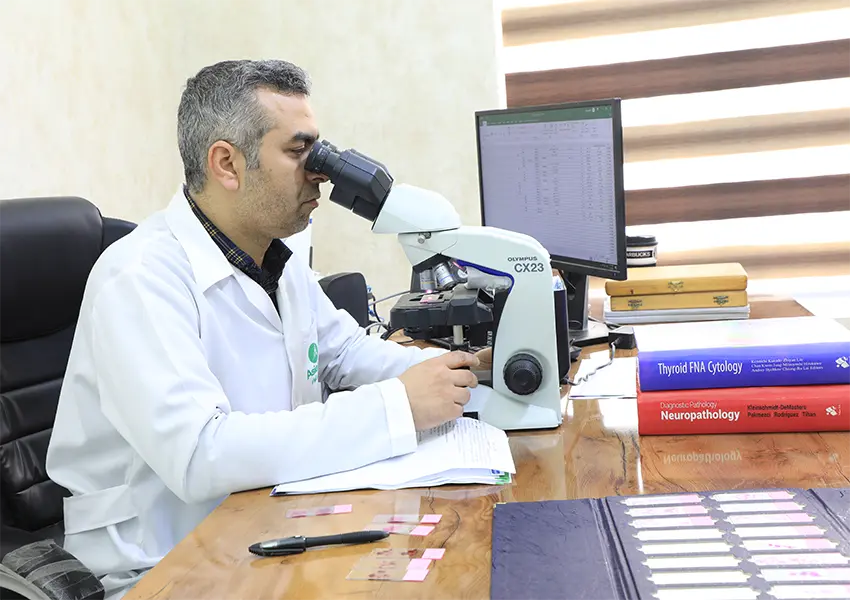
A specialist who examines tissue and body fluid samples, and with the help of laboratory instruments and microscopic techniques, assists in diagnosing diseases and cancers.
Pathology Sample Submission Guidelines
When submitting tissue samples, the following points should be observed:
- The surgeon should prevent the sample from being fragmented as much as possible.
- For certain samples such as breast, colon, skin, or others requiring margin assessment, the sample should be marked with a thread or label, or the margin should be clearly indicated.
- Patient details including name, father’s name, sample location, age, sex, etc., should be written on the container and pathology request form.
- Patient history and other relevant information should be included on the request form.
- Patient documents such as laboratory tests, ultrasound, CT scan, MRI, X-ray, endoscopy reports, and previous pathology results are necessary for accurate diagnosis.
- The sample container should be of adequate size so the sample can be easily placed inside and removed.
- The container should have a lid and be securely closed.
- Samples should not be sent in unusual containers such as serum tubes, syringes, open containers, or wrapped in gauze.
- All tissue samples should be placed in 10% formalin fixative.
- For testicular biopsy, Bouin’s solution is preferred.
- The amount of fixative should be enough to fully immerse the sample.
- Using diluted formalin, serum, alcohol, or other substances will damage the tissue and make pathology examination impossible.
For fluid samples:
- Fluid samples do not require fixative but must be sent immediately to the laboratory.
- If the fluid is sent with delay, it should be stored in a refrigerator until delivery, not in a freezer.
- If urine is sent from a remote location for cytology, 50% alcohol should be added in proportion to the urine volume.